Winter is Coming!

Winter is coming! OK, so we’re not actually expecting hoards of White Walkers to come pouring over the state line from New York like some “Game of Thrones” nightmare, but here on the eastern edge of the States you can definitely feel the change of seasons.

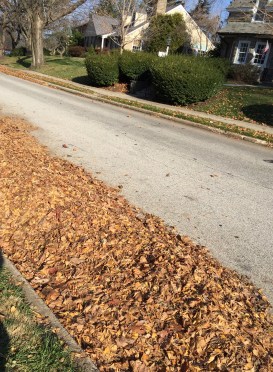
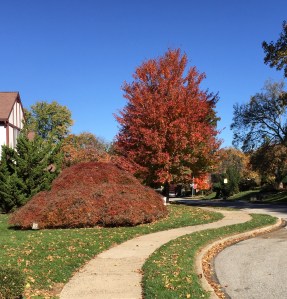
This morning the Borough (local Council) did the last leaf collection of the season. Four times in November/December, the Public Works crew comes around in a lorry with a massive vacuum chute attached that sucks up any piles of leaves that homeowners have raked and blown into the gutters. These pictures show the local streets yesterday afternoon.

fullsizeoutput_571fullsizeoutput_573

Thanks to an unusually mild fall, the leaves were late to drop this year, so there were bigger than usual piles for the final pick-up.

And it didn’t come a day too soon. After that mild autumn the swing to winter has been abrupt and painful. The high temperature at midday today is a frigid 23 fahrenheit (that’s -5 celsius). And the weather forecasts have started the dreaded seasonal addition of “wind chill” temperatures — what the actual feel is like on your skin when a strong gust of wind passes by. Today, with gusts of wind hitting 40mph, the wind chill is somewhere in single digits.

fullsizeoutput_572

There were a few flurries dancing in the air late last night when I took the dog out and the current forecast predicts an inch or so of snow Saturday morning — not enough to seriously inconvenience anyone, but a clear sign that the season has changed. These late blooms on the neighbor’s rose bush are in for a nasty shock.


This morning you can certainly feel the shift — a sky of lowering, pale grey clouds that whisper of snow and (despite the wind) a chill stillness in the air. The squirrels have ceased their frantic search for nuts to cache away for the lean months and are hunkered down in their nests — the only things left in the trees that have shed their leaves.

I haven’t seen hide nor hair of the local chipmunk colony in a few days, and the rabbits that seem to have a burrow somewhere at the bottom of the garden have gone into seclusion. Time to hunker down, and hope this winter isn’t too brutal.

Posted in Uncategorized | 2 Comments

Afters, Biccies, and Sweets, Oh My!

With Thanksgiving out of the way we’re now firmly into “Holiday Season” here in the States — which means indulgence. Also “buying stuff,” but let’s focus on the food for now.

Afters (Desserts)

To start with, there’s no such thing as Christmas pudding or mince pies over here. In the UK right now, you probably can’t take two steps without seeing plates, boxes, and displays of them everywhere, but here they’re confined to a few specialty stores. In the States there’s no such thing as a recognizably “christmas dessert” of any kind. Instead, people will decorate generic cakes and cookies (biscuits) with something festive-themed.

In fact, there’s no such thing as “pudding” at all, at least not in the British sense. There’s no sticky toffee pudding or spotted dick or jam roly poly. Instead, “pudding” in the States means something like an Instant Whip confection, eaten chilled. And “custard” here means either an egg-based baked flan-style dessert or, confusingly, a certain style of rich and creamy ice cream — but definitely not a thick and yummy liquid to drizzle over a pudding (remember mashing the chocolate pudding into the chocolate custard at school dinners? Heaven). And the final straw: most cakes don’t have a proper cream-based filling but some ghastly confectioners concoction that tastes like it was extruded from old tires and never saw a cow.

Still, all is not lost on the dessert front. You can get really good ethnic-based specialties in all the big cities, and general American cuisine excels at pies: apple and pretty much any kind of fruit you can imagine, gets made into pie. There’s Mississippi mud pie (really, it tastes divine, made from copious amounts of chocolate) and one of my favorites, key lime pie. Also, pecan pie, sweet potato pie… The list is pretty much endless.

img_0495Here in Pennsylvania there’s an Amish specialty called shoofly pie (reportedly so named because all the sugar attracted flies that, yes, you’d have to shoo away). It’s like a really dense cake mix with a thick, gooey molasses bottom. A good shoofly pie has enough sugar to make your teeth ache after one mouthful.


Biscuits (Cookies)

Biscuits, of course, are called cookies and no you won’t find any of the familiar British biscuit brands in the USA. Except for Walkers Shortbread which, for some reason, is widely available, even in the local supermarket.

For the first few years I was here, I really missed things like Jaffa Cakes and Hobnobs and good old McVities. Eventually, you realize that a really good chocolate chip cookie can make up for the loss. And then there’s snickerdoodles — an old fashioned cookie with a sugar cinnamon coating and a sweet and buttery flavor. Yum.

img_0496

Sweets (Candy)

It has to be said. America: your candy is awful. Too much artificial flavoring and way, WAY too sugary.

img_0497

The chocolate is particularly ghastly. It feels a bit treasonous to say this, given that Pennsylvania is home to Hershey’s, one of the largest and most recognizable chocolate manufacturers in America — but American chocolate is just dreadful. British chocolate tends to have a higher fat and cocoa content; American-made chocolate contains a larger dose of sugar. UK rules say that a product must contain no less than 25% cocoa solids to be considered “milk chocolate.” The US rules, on the other hand, call for milk chocolate to contain no less than 10% chocolate liquor.

img_0498

The fact that Brits loath most American “candy” is pretty much a universal truth. Google the phrase “American chocolate” and you’ll quickly get a series of articles and pictures expounding on the theme. A colleague at the US-based corporation I used to work for, told me that when he spent a year at the company’s London branch he took a big bag of American candy with him, so that he could put a bowl of candy on his desk for coworkers to sample. After six months, the bowl was still full.

You can find Cadbury’s over here but not only is it more expensive, it’s not the real thing. Hershey’s holds the rights to manufacture Cadbury’s in the States, and although the UK-based firm ships them a dry mix of cocoa solids and milk, Hershey then “completes the manufacturing process,” which can include ‘tweaking’ the recipe to suit American tastes. Hershey even went so far last year as to sue a couple of large importers of British products to prevent any UK-made Cadbury’s products being brought into the USA. The resulting “chocapocalypse” triggered an avalanche of social media protest from lovers of British chocolate, and Hershey’s seems to have quietly dropped any further suits. The good news is that smaller importers are still bringing in the goodies. My favorite is at http://www.jollygrub.com.

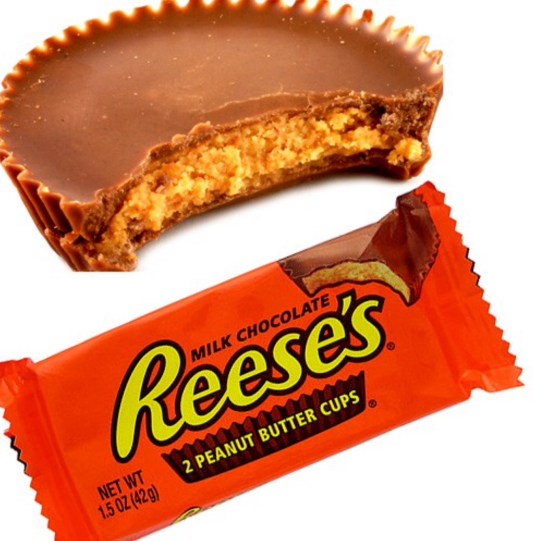
The one redeeming feature of American candy is peanuts. Where hazelnut is the default nut flavoring in the UK, here it’s peanuts. I don’t know why but even American chocolate tastes good when paired with the filling in a Reese’s peanut butter cup.

img_0499

Posted in Uncategorized | Tagged , , , , , , , , , , , , | Leave a comment

Pearl Harbor Remembrance Day

I noticed on the kitchen calendar this morning that tomorrow is Pearl Harbor Remembrance Day here in the States. This isn’t a federal holiday — nothing closes — but there will be stories aplenty in the media about the Japanese attack on December 7, 1941. In a speech to Congress, President Franklin D. Roosevelt called the bombing of Pearl Harbor “a date which will live in infamy.” The following day the USA declared war on Japan and entered WW2.

Pearl Harbor was certainly a devastating attack: 2,403 citizens were killed at the naval station in Honolulu and many more were wounded; two battleships were sunk; five more battleships, three cruisers, three destroyers and a minelayer were damaged; and 188 aircraft were destroyed and 159 damaged. The attack came without warning and without a declaration of war.

I’m not disparaging the loss of life, or the importance of veterans and military sacrifice in general (there are plenty of veterans in my own family, including a nephew who served in the Royal Navy). But, it always surprises me a little that so much fuss is made of one event in what was, for the rest of the world, a six-year long war punctuated with appalling acts of destruction and suffering. Which got me to thinking about the ways in which the USA has experienced war differently from Europe.

European War Memories

Like most baby boomers, I grew up on stories of the Second World War — not just a father who fought across the sands of northern Africa and up into Italy, and a grandfather who served all across Asia, but civilian stories, too. A mother who worked in the army records office and slept in air raid shelters or under the kitchen table; an aunt who served in the Land Army; younger aunts and uncles evacuated from London during the blitz. My generation grew up on memories of the sound of buzz bombs (the German V1 flying bombs) and the terror when the sound stopped because that meant the bomb was plunging toward earth. Stories of rationing and hardship; and of glee, when one of the women at the army office got ahold of an old parachute, which meant they could share out yards and yards of silk that could be made into clothes. And further back, one of my grandmothers remembered hiding under her kitchen table as a teenager in 1914-18, when German zeppelins made bombing runs over London in the First World War.

The immediacy of this war was even more intense, of course, for continental Europe. An American friend of mine did her graduate studies at the University of Leuven in Belgium. She told me that there’s a plaque on the wall of the Leuven Library, commemorating how it had been rebuilt after the Second World War with the help of funds from the UN. Just below it is another, more battered plaque that describes how the old library was rebuilt after the First World War with the help of funds from the League of Nations. Behind these two plaques is an achingly painful story of repeated waves of destruction and suffering.

America is Still Young

But, for Americans, the Second World War (along with the wars in Korea and Vietnam) was something that happened far away — yes, it impacted the people back home, but no-one here was bombed. Aside, that is, from Pearl Harbor. Which perhaps explains why it still holds such a place in the American collective psyche. It certainly helps explain the profound impact of the attacks of September 11, 2001.

Partly this is a young country phenomenon. America is still creating its collective memory of nation-building and the country’s place in the world. There’s plenty more that could be said about more recent conflicts; about the (American) Civil War; about the collective amnesia surrounding the 17th and 18th century invasion and genocide that underpin the creation of the United States. But in terms of attacks on the USA from outside, the stories are rare.

If the UK were to designate days of major military attacks in history, the calendar would be chock full — where would you stop? Of course, Brits do remember and remark on things like the Battle of Hastings (October 1066 if you’re wondering), and in Leicester there are still people who put white roses on the stone in Leicester Cathedral that commemorates the death of King Richard III at the Battle of Bosworth in 1485. But not to the extent that the dates are routinely printed on a nondescript calendar.

Tomorrow is the 75th anniversary of the attack on Pearl Harbor so the commemoration ceremony in Hawai’i will get even more attention than usual, and there will be smaller events at VFW (Veterans of Foreign Wars) halls across the country. And I’m sure more than one TV channel will be broadcasting “From Here to Eternity.”

Posted in Uncategorized | Tagged , , , | 2 Comments

Weather Reminds Us That America is … Big

It’s easy to forget, sometimes, just what a big country the USA is. For a Brit, one of the best ways to grasp this size is to take a look at the weather. This is today’s national forecast map from the Weather Channel. Take a look at the temperature variations.

img_0493

It’s about 3,800 miles as-the-crow-flies from Philadelphia to LA, yet in all that vast distance there is little change in language or culture. Yes, I know, people in rural Pennsylvania might think California is like a foreign country; and fizzy drinks are called either soda, coke or pop depending on where you are. But these differences are pretty superficial.

To put it in perspective, 3,800 miles is just a bit more than the avian distance from London to Van in the far east of Turkey — a journey that would take the weary crow across the skies of Belgium, Germany, the Czech Republic, Slovakia, Hungary, Romania, and the entire width of the Black Sea. Think about how much language and culture changes on that journey and you’ll see what I mean about American culture being relatively homogenous from a geographic point of view. (There’s a lot of variation within the country ethnically, but I’d bet that an Italian-American family in Philadelphia has much more in common with an Italian-American family in LA, than would almost any family in Leicester with one in eastern Turkey.)

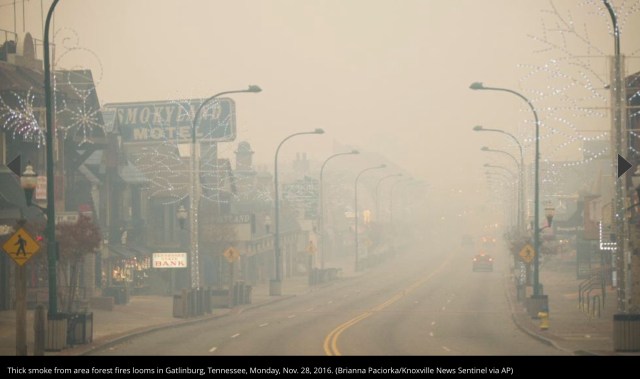
But sometimes there’s a news story that brings home to me just what a bloody big country this is — and today it’s the weather. Specifically, weather disasters. In the past 48 hours the news here has been full of images from Tennessee, where a horrendous wild fire in the Great Smoky Mountains has prompted the evacuation of thousands of people, including the residents of the town of Gatlinburg in the mountainous eastern part of the state. These are just two of the pictures currently posted on the Weather Channel site.
IMG_0487.jpg

img_0488

Meanwhile, a winter storm has been barreling across the northern plains states, leaving four feet (yes, FEET) of snow in the mountain areas of Wyoming and threatening the protestors camped out at the Dakota Access Pipeline protest in Standing Rock, North Dakota. Today’s temperature in Elk Mountain Wyoming is forecast to reach a high of 20 degrees fahrenheit — that’s -6 celsius. After swinging across Canada, the storm is now threatening the northern parts of New England, in the north-eastern US.
img_0491

Severe thunderstorms have been pounding their way across south-eastern parts of the country, and deadly tornadoes ripped through Alabama and Tennessee last night. The storms continue to threaten north-eastern Louisiana and Mississippi. This local weather map from last night gives stark warning.
img_0490

And, out in Los Angeles, it’s been warm and dry and sunny, with today’s high forecast at 76 degrees (19 celsius). Actually, it’s too dry — drought continues to plague much of the western seaboard.

Here in the Delaware Valley region, we’ve had very mild temperatures for a few days — today’s high should reach 61 fahrenheit, or 16 celsius. But, it’s been raining steadily for over 24 hours, and is forecast to keep raining for the rest of the day. After an unusually dry couple of months, this is actually quite welcome; although, all the leaves that have fallen over the past couple of weeks are now sodden masses clogging the gutters and downspouts, making roads and pavements downright treacherous.

Less welcome was the dense fog we woke up to this morning. This is a lovely picture from the “Only in Your State” website, of downtown Philadelphia’s skyscrapers disappearing into the fog — driving through it is much less appealing. Preferable, though, to wildfire, heavy snow or tornadoes.

img_0492

Posted in Uncategorized | Tagged , , , , , , , | Leave a comment

Driving in America

You can’t write about living in America without talking about cars — particularly if you live in the ‘burbs. To say this is a “car-oriented culture” is an understatement; suburban shops and entertainment places are built around parking lots (car parks) and parking garages (multi-story car parks). People assess how far away something is by how long it takes to drive there. It’s not unusual to drive half an hour — or more — to get to a favorite restaurant.

The obvious difference for a Brit over here, of course, is driving on the right side of the road. Along with the driver’s seat being on the left of the car, you have to get used to using that left side wing mirror all the time, and you have to train yourself to look up and to the RIGHT to see the rear view mirror. Until you get used to the difference, backing up is quite a challenge.

So. Many. Cars.

But, in addition to the whole driving-on-the-right thing, there are a host of other differences between driving in the States and driving in the UK. And the scariest, for me, is the sheer volume of traffic, particularly on the interstates (major motorways that, well, connect between states). Yes, there is heavy volume on the M1 in the UK, particularly in rush hour; and yes, anyone fool enough to drive into London is in for a traffic nightmare. But the eastern seaboard of the USA is much, much worse.

img_0485When you drive over the Ben Franklin Bridge from Philadelphia into New Jersey there’s a point where a couple of highways and smaller roads merge and suddenly you’re in the midst of seven lanes of traffic, all headed in the same direction. And all going very fast. This picture is coming over the Bridge in rush hour — it gets worse from here.

According to the Federal Highway Administration, about a quarter of all vehicle miles driven in this country use the interstate system. Built in the 1950s (apparently as a way to move troops around in the event of an invasion), the main interstates have two-digit names, with even numbers for east-west routes (like I76, which runs 435 miles from near Akron, Ohio, into New Jersey) and odd for north-south (like I95). Spurs that tend to service the cities get a three-digit number (I276).

Drivers on highways and even smaller roads “undertake” (pass in the slow lane) all the time; which makes overtaking a big truck really nerve wracking as you never know if some idiot is hurtling up the inside (right) lane ready to pull back in front of the truck at the same time that you are trying to return to the middle lane after dutifully passing on the left. There’s no admonition not to “hog” the center lane on a three-lane highway. And, if you’re pedantic enough to sit in the fast lane at the speed limit, you’ll get honked at. A lot.

Maximum speed limits are actually set by each state; on freeways/major highways, unless otherwise indicated, the speed limit is the state maximum. Here in Pennsylvania, that’s 70mph (yes, it’s all miles over here — and gallons, and yards — no metric anywhere). Out in rural west Texas and Utah, there are some highways sections with speed limits of 80mph.
img_0481One of the hardest things to get used to when on a major highway of any kind is that they don’t usually have lane markings as directions. So you have to look for overhead signs at the same time as hoping the people to either side don’t suddenly decide to change lanes. Which is another of my big-truck fears — get stuck behind one and you may not see the signs to exit or change lanes until it’s too late and you suddenly find yourself headed north instead of west.

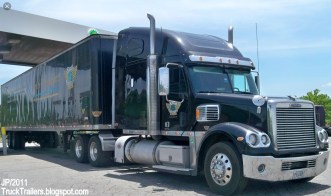
And about those trucks (no, I can’t call them lorries; that’s just not a big enough word). They can be huge. I mean enormous, gigantic behemoths…there isn’t enough hyperbole.

img_0483Back in the summer I took a visiting English relative out to Lancaster County, west of where we live, to see the countryside and the world of the Amish. When we stopped at a local ice cream parlor she suddenly whipped out her camera — not to take pictures of passing Amish horse-drawn buggies, but to snap the massive trucks blasting down the road. Imagine spotting one of these in your rear view mirror, when hurtling along an interstate at 70mph.

Everything Looks Different

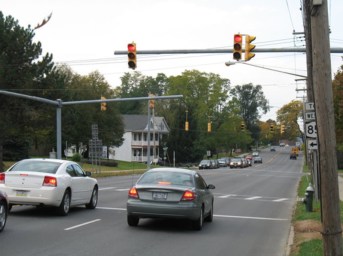
img_0479Away from the interstates, the road architecture is still very different. Road signs tend to be more brusque — “yield” rather than “give way.” Traffic lights are usually hanging out over the road rather than standing to one side — which gets unnerving in windy weather when the whole contraption starts bouncing up and down alarmingly.

IMG_0480.jpg

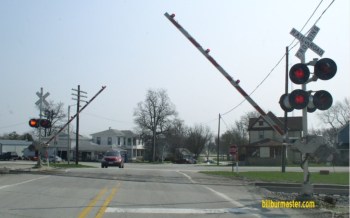
There are almost no roundabouts (“traffic circles”); and the few that do occur tend to confuse the heck out of American drivers. Instead, there are stop signs at intersections. Railroad crossings in the neighborhoods are startlingly naked, just one flimsy arm that
swings down if a train is coming.

And then there’s “right turn on red”: the one American traffic rule guaranteed to have any UK visitors clutching at their seats in a panic. Bearing in mind that you’re already driving on the right-hand side of the road, this is exactly what it sounds like — you’re allowed to turn right at a red traffic light, provided you’ve come to a complete stop and there’s no traffic or pedestrians in the intersection.

The Scariest Drive of All

But I have to admit that even the terror of the Ben Franklin Bridge in rush hour pales into insignificance compared with some back roads in the UK, in places like Cornwall or Cumbria. Or, the mountain roads in Snowdonia — a sheer drop on one side, a soaring hill on the other, sheep everywhere, and the dotted white line down the middle of the road suddenly disappears as the road narrows alarmingly. What are you supposed to do if you encounter someone driving in the other direction? Fortunately, I’ve never found out.

A few years ago, on a family trip to the UK, we spent some time in Cumbria. One night, we visited a local pub a few miles from where we were staying. At closing time, we found out that the only way out of the village was actually the same as the way in — a mile-and-a-half of narrow, winding road that was about two feet wider than the rented car, with thick six-foot tall hedges on either side. It was 11pm, and pitch-dark (no nearby towns to give off ambient light).

And then the fog came down. THAT was the longest drive of my life.

Posted in Uncategorized | Tagged , , | Leave a comment

Thanksgiving and Black Friday

This week brings the most American of all holidays — Thanksgiving. Celebrated the fourth Thursday in November, it’s easily the biggest celebration of the year; the day before is easily the busiest travel day of the year. School children have spent the days leading up to Thanksgiving with craft projects like making turkey pictures from hand prints; constructing turkeys out of a pear and cut-out bits of cardboard; and listening to stories about plucky pilgrims and the gentle Indians who helped to feed them on the “first Thanksgiving.”

Like any history-based observance, it’s a sanitized and mythologized rendering of what may or may not have happened (in this case, the arrival of Europeans in the Americas, skipping over any notion of cultural imperialism and the advent of genocide). And this being America, where shopping is a national pastime, a retail component has been added.

Thanksgiving

It’s actually a fun holiday that is celebrated by everyone, regardless of race, religion, or national origin (with the stark exception of most Native Americans — but no-one comments on that). Interestingly, historical accounts of the meal shared by the pilgrims and the Wampanoag back in 1621 make no mention of turkey. Apparently it was writer Sarah J. Hale (1788-1879), she who penned “Mary Had a Little Lamb,” who urged people to eat turkey and who got Abraham Lincoln to make Thanksgiving a national holiday in 1863.

Almost five hundred yeas ago, the pilgrims probably chowed down on venison. (Imagine trying to serve up Bambi at a family dinner.) Different families have their own ethnic spin on what gets served at a Thanksgiving feast, but today a turkey is always the centre-piece. (Which is why there’s a rather daft tradition of the President ceremoniously “pardoning” a turkey on the White House front lawn every year, a practice that seems to have emerged gradually since the 1950s and has now become a required annual photo-op.) Most of the turkeys consumed on Thursday will have been commercially raised, and bought frozen from a supermarket. So print and online media are full of advice columns this week on the right/best/easiest/safest way to defrost and roast a turkey.

The basic Thanksgiving meal includes sweet potatoes (usually in a casserole with marshmallows added — yes, marshmallows, I don’t know why); a green veg like green beans; potatoes (roasted and/or mashed); stuffing; gravy; and cranberry sauce. Along with lots and lots of desserts (pumpkin pie, pecan pie, apple pie…you get the idea).

The goal is to stuff yourself into a carbo-loaded stupor, not fight with any relatives, and at some point slump in front of the TV and watch The Game. This means a nationally-broadcast football game (American football, of course). Earlier, your day may start with the TV broadcast of the big Macy’s parade in New York — this week will be the 90th — which has spectacular floats, entertainers, and massive balloon creations. I suspect a lot of people only watch to see if there’ll be a balloon mishap (there’ve been quite a few over the years). The small town where I live has a delightful tradition of a father-son pickup football game at the high school playing field on Thanksgiving morning, a haphazard affair that probably started with gettin’ the menfolk out of the way while the women got down to the serious business of cooking.

Black Friday

Assuming you survive the food and the relatives, the day after Thanksgiving brings another quintessential American event: Black Friday. It’s basically the start of the Christmas shopping season, and many shops will have “special Black Friday deals,” opening at the crack of dawn to offer massive discounts on TVs and toys to the first shoppers through the door. Because only in America can people spend a day talking about all the stuff they’re thankful for, before going out to buy yet more stuff.

Yes, people do get up early to hit the stores on Black Friday; and yes, there are stories every year about hapless shoppers getting injured, even killed, in a stampede for a bargain. I’m not sure how thankful a retail worker is going to be, if they have to be at work at 4:00 a.m. the next day to prepare for a 5:00 a.m. store opening. With some places going so far as to open late in the evening on Thanksgiving day itself, there are now a number of larger chain stores who advertise how family friendly they are, by not opening on Thanksgiving for the sake of their staff.

People generally assume that it’s called Black Friday because this is the day when retail stores finally turn a profit (i.e., their accounts go from red to black). Actually, the biggest shopping day of the year for most retailers is usually the Saturday before Christmas. Either way, the origins of Black Friday started here in Philadelphia, back in the 1950s, and didn’t really spread to the rest of the country as a widespread retail thing until the 1980s. And the origin had nothing to do with sales and everything to do with a major law-and-order problem.

The Philly cops used the term to describe the chaos they faced the day after Thanksgiving, when hordes of suburban shoppers and tourists flooded into the city — not just to shop, but also to get ready for the big Army-Navy football game that was held on the Saturday. (A tradition that started back in the 1890s, in recent years the game has shifted to a date in December.) The beleaguered cops couldn’t take the day off, and had to work extra-long shifts dealing with the crowds and traffic. Reportedly, shoplifting was particularly rife as people took advantage of the chaos.

And now it seems some UK retailers are trying to push the Black Friday concept — adopting the worst aspect of an American tradition without any of the underlying history or wider context. At least here in the States people have spent a few days pondering all the things they have to be thankful for, and reconnecting with kith and kin, before getting sucked into the shopping day from hell.

Without the bookends of turkey the day before and an army-navy sports rivalry the day after, you’re left with overworked cops and shop workers, and a deluge of adverts. Enjoy.

Posted in Uncategorized | Tagged , , , | Leave a comment

The Beauty of Fall

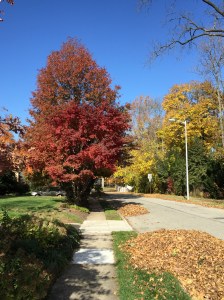
Fall is my favorite season here in the mid-Atlantic region of the States. Back in the UK, autumn’s dominant color is grey — grey clouds, grey skies, grey mood — with a background of soggy brown that gradually fades into chill winter. (Yes, I know, places like Cumbria and Scotland can be beautiful in October but I grew up in Leicester and London — so, grey.) But here in suburban Philadelphia, fall is a glorious riot of color, with trees and shrubs erupting into every conceivable shade of the spectrum from bright lemon yellow through vibrant orange and all the way to deep, russet burgundy.

img_1456
These pictures were taken over the past month in my neighborhood. Apologies for the hasty composition — they’re just snaps taken with my phone (usually with an impatient dog tugging on the leash, irked that her morning walk was being interrupted yet again).
img_1455

I have no clue what these trees and shrubs are called (again, city girl). But I invariably walk around in October and early November sporting a daft smile, entranced by the beauty

img_1469

I had expected to be able to post these a few weeks ago, complete with a panorama shot of my street at its most colorful; but the weather has been unusually warm for the past few weeks, which seems to have confused the trees no end.

img_1463

Some turned color back in late September; others are only now getting around to it.

img_1467

In addition to the riot of color, there’s a distinct odor to fall — and it’s not moldy leaves and damp clothing. Every shop from the corner store to the largest supermarket has a distinct background whiff of pumpkin spice, perhaps with a hint of cranberry. There’s an entire aisle of pumpkin-flavored products at the local Trader Joe’s; the local bakery has cranberry-nut or pumpkin muffins; and Starbucks is serving up its annual “pumpkin spice latte” (which always strikes me as a dreadful thing to do to a perfectly decent cup of coffee, but some people love the stuff).

The fall weather is mostly wonderful. There’s the odd day of chill, driving rain but most of October into November the days are crisp and clear. Part of the delight of fall is the sense of relief after the often-brutal heat and humidity of the summer months. After 30 years in this country I still wilt when the temperature hits 90 degrees (32 celsius) with a humidity level to match.

Except this year. Instead of topping out just over 50 degrees fahrenheit each day (that’s about 10 degrees celsius), the temperature has stayed in the 60s most days, occasionally getting as high as 70 (21 celsius).

This must be why the squirrels are far more laid back than usual for the time of year. Usually, by mid-November they’re scurrying around everywhere, frantically burying everything potentially edible in preparation for winter. I don’t know if they cue their behavior off the trees or the temperature, but I have’t seen near as much scurrying as usual. Which bodes ill for the squirrels this winter.

Posted in Uncategorized | Tagged , , | Leave a comment

Aftermath of the Presidential Election

I’ve spent the past 36 hours trying to decide whether — and how — to write about the presidential election that happened on Tuesday. This isn’t a ‘political’ blog and I don’t want to unleash a rant on my readers; on the other hand, it’s impossible to be a resident of the United States right now and not have something to say about the election and its outcome, so bear with me. Because, let’s face it, almost no-one saw this coming.

Immediate Aftermath

For starters, there’s the “failure of the polls” stories that are everywhere. Personally, I think it’s more accurate to talk about “the failure of model interpretation” but that doesn’t sound nearly as pithy. Media and commentators of every hue presented the various voting model predictions as ironclad results — but instead of saying “there’s an 85% chance of Hillary winning” they should have been adding “assuming that turnout demographics match our underlying polling samples as well as previous elections.” Definitely not pithy.

Simply, Democratic voter turnout was lower, and Republican turnout higher, than implied by headline model summaries.

There’s also a great deal of chatter in some circles about the “problem” of the Electoral College system, an issue that crops up periodically in American politics. I wrote about the mechanics of the College before [The U.S. Presidential Election]. It’s not lost on many Democrats that Hillary won the popular vote (just) but lost in the Electoral College, as did Al Gore in the 2000 race against George W. Bush. As the role of the College and its procedures are laid out in the U.S. Constitution, an amendment would be needed to change the process — but I wouldn’t hold your breath. It’s a very long-drawn-out and arduous process that stands little chance of success without widespread bipartisan support.

To summarize, an amendment needs to be proposed by the Congress with a two-thirds majority vote in both the House of Representatives and the Senate; the subsequent joint resolution then goes to each of the 50 States for debate and a vote in their legislatures. A proposed amendment becomes part of the Constitution once it is ratified by three-fourths of the States (i.e., 38 of the 50).

In other words, if challenges to the Electoral College are seen as a Democratic Party complaint, any such attempt will be dead in the water, at least for the next four years.

America Divided

But more important than any of this is the staggering degree of divisiveness manifesting across the country. People on both sides are very angry, and publicly so. The day after the election, there were massive demonstrations against Trump in major cities on the east and west coasts (and also in Chicago, which often feels like an east coast city despite being bang in the heart of the mid-west). I saw one report claiming the New York protest on Wednesday evening was 20 city blocks long — that’s about two miles.

I’ve heard of professors at universities cancelling classes on Wednesday on the grounds that their students would feel traumatized and would need time to process the results before getting back to their studies. I’ve also heard anecdotes of Republican-supporting students being seriously bullied on campuses. And plenty of Republican commentators are bemoaning what they see as Democrats’ unwillingness to accept the results.

There were certainly protests and complaints after Al Gore lost in 2000, but they focused on the flawed electoral procedures in the key state of Florida (remember those ridiculous hanging chads?); and ultimately, the deadlock was resolved by the Supreme Court. Even as they lamented the outcome, most Democratic commentators (and all of the ones I know) emphasized that America resolves its electoral disputes in the courts, not on the streets.

Somewhere in the past 16 years, that sentiment seems to have shifted. Certainly a whole generation of young voters have grown up taking it for granted that the tide of political progress is basically liberal (in the American sense). They now face a Republican Congress and President who are intent, if we take their statements at face value, on reversing much of that progress. People tend to get angry when their rights are taken away.

I know of Republican supporters who said that the party’s tax and other policies were so important to them that they “looked past” Trump’s racist and homophobic statements, not to mention his overt misogyny (which I guess is easy to do when you’re white and/or straight and/or wealthy enough not to feel threatened). Liberals find that stance hard to swallow.

I was struck, when I first came to this country, by the widespread acknowledgement, on both sides of the bipartisan divide, that whatever you may think about a particular individual, you always have respect for the office of the President. The vitriol of parliamentary political debate was notable by its absence. But things started to slide in 1987 when Democrats furiously denounced Reagan’s nomination to the Supreme Court of conservative judge Robert Bork, which arguably contributed to the Republican backlash against Bill Clinton after he was elected in 1992.

Things seemed to calm down somewhat in the aftermath of the terrorist attacks of September 11, 2001. But they definitely accelerated again after Obama’s election in 2008. Some of his detractors channeled their anger into the so-called “birther” movement, challenging whether he was a “real” American in what was essentially veiled racism.

And now America has a president-elect who not only championed the birther movement, but also espoused outright racism against Mexicans and Muslims.

There are cycles to American politics, just like in any democracy, and the optimists will say that the cycle will turn again. In that earlier post on the presidential election, I mentioned the Schumpeter business column in the October 15 edition of The Economist magazine. We are now facing the consequences of a 20-year rise in the business of extreme media: “the entrepreneurs of outrage and barons of bigotry” have succeeded in installing a mouthpiece in the Whitehouse.

I can only hope that the next four years do not irrevocably damage this great country, and that Dr. Martin Luther King, Jr. was right when he said: “The arc of the moral universe is long, but it bends towards justice.”

Posted in Uncategorized | Tagged , , | Leave a comment

Surviving the Election With An American Breakfast

Tomorrow (November 8) is going to be a very long day. The polls open at 7:00 a.m. here in Pennsylvania and close at 8:00 p.m., but it’ll be another three hours before voting ends on the west coast. It will likely be the wee small hours of Wednesday before we have an idea of who won the presidential election, not to mention the various House and Senate races.

The only way I’m going to get through it is to fortify myself with a full American breakfast. I’m not talking about those ghastly neon-colored cereals that clog the supermarket aisle; rather, a plate piled high with eggs, homefries, toast and maybe pancakes, washed down with endless cups of coffee, probably courtesy of our local restaurant West Avenue Grill (www.westavegrill.com; they do seriously-great omelets and really good coffee).

The Good (and Not So Good) Stuff

The concept of “going out to breakfast” was still unheard of in the UK when I left 30-odd years ago, and was one of the things that I quickly fell in love with over here. It was also the one thing our recent UK visitor asked for, before heading back home. The specifics of what’s on the menu will vary by region, but here on the eastern seaboard it’s all about eggs, potatoes, bacon and pancakes. And coffee, endless coffee, with the wait staff periodically wandering by with a full pot and asking “top up?”

This time around I took the visiting relative to Michael’s for the full American experience — a nearby diner that’s open 24 hours, and has a massive menu that includes breakfast items available all day long.

After spending a few minutes perusing the menu, she asked: “Scrapple? What’s that? Do I want it?”

Every region in the US or UK has at least one menu staple that outsiders shudder to contemplate. Black pudding anyone? (American readers: if you don’t know what black pudding is, look it up, but not if you’re eating.) The Pennsylvania specialty is scrapple — basically, all the leftover bits of a pig that aren’t otherwise eaten, mixed with corn or wheat flour and spices, then fried. It smells revolting, like any sausage of dubious provenance, and I’ve never tried it. So, no scrapple for the visitor.

Homefries and hashbrowns, however, are delicious. The former is basically chunks of cooked potato, fried up with onions; hashbrowns are similar, but grated. Done right, you get a big serving of slightly-crispy-on-the-outside potatoey goodness that goes a treat with any kind of eggs. Down south the breakfast favorite is grits: ground up cornmeal. The resulting yellowish mush looks like porridge gone wrong. Most southerners I’ve met get a look of fervent near-worship in their eyes when they talk about grits. I guess it’s an acquired taste.

Another wonderful discovery over here are pancakes (in some places rather confusingly called hot cakes). Not thin and sugar-drenched confections, these are plate-sized, fat and fluffy; and because this is America, they come in a myriad of choices. My favorite: loaded down with fresh blueberries. There’s an entire restaurant chain called IHOP (International House of Pancakes) that, among other things, has pages of pancake options: strawberry-banana; raspberry white chocolate chip; harvest grain and nut; pumpkin spice… you get the idea. But beware the “syrup” that most places serve with their pancakes; it’s a ghastly sugared confection that’s never been anywhere near an actual maple tree.

Bagels are another American breakfast staple that I’ve grown to love. I know you can get them more easily in the UK now than was the case 30 years ago, but I doubt you’ll find anything like the real thing — fat and chewy and loaded with doughy flavor. Some people swear by onion or poppy seed bagels but, again, the range of options is incredible. Cinnamon-raisin? Blueberry? Rye?

At this time of year the dreaded pumpkin flavor surfaces for a month or so. And in a delightful bit of American cross-cultural hybridization, many places produce green bagels on St Patrick’s Day.(Another local plug: Fill A Bagel bakes fresh on-site every day and has the best bagels, http://www.fillabagel.com).

What’s Missing

The one thing you won’t find in any restaurant, and will struggle to produce at home, is toast and marmite. As someone who’s firmly of the view that marmite is akin to ambrosia and should always be found in any halfway decent kitchen, this has been a real problem over the years. You can buy it in the more upscale supermarkets, but only the tiniest jars. Fortunately, no-one else in the family will challenge me for it; my oldest quite likes marmite, but the youngest does not, and the American husband ranks it as akin to liver and firmly on his list of things-that-should-never-be-eaten. Any visitor from the UK knows to smuggle at least one of the oversized jars into their luggage; bring me two, and you can stay as long as you like.

And then there’s the tea. There are very few varieties of black tea available in most supermarkets, albeit shelves full of “herbal” teas are common. There’s a store at the big mall near where I live called “Teavana” which does sell loose teas but mostly various floral concoctions, and all seriously over-priced. I haven’t seen Lapsang Suchong anywhere here.

And don’t even get me started on “iced tea” — or, as I call it, the abomination. Bottles of the stuff occasionally appear in my fridge; I try not to notice.

Every Brit expat probably has a horror story about trying to get a decent cup of tea in the States. My own happened about a month after I arrived here as a graduate student. I wandered into the local eatery on campus and innocently asked for a cup of tea with my sandwich.

I should have known that this was going to go horribly wrong when the server asked “Iced?”

“Er, no, hot please.”

“With lemon?”

“What? No! With milk!”

After staring at me for a moment like I was some kind of crazy, she picked up a styrofoam cup, filled it with hot water, added a splash of milk, crammed on a plastic lid, placed a teabag on top of the lid and handed me this foul concoction.

I slunk over to my seat, and quietly wept.

From that day on, I’ve drunk coffee. Fortunately, it goes very well with blueberry pancakes.

Posted in Uncategorized | Tagged , , , | 1 Comment

An English Visitor Meets CVS

It takes a visit from someone “back home” to remind me of the little things that are different over here. Recently, a relative from the UK wrapped up a week-long trip to the States with a couple of days in the Philly suburbs. She’s stayed with us before, but every time there’s something new that creates a moment of confusion.

This time around it was a quick trip to the local CVS (sort of an American version of Boots the Chemist).

For starters, she was baffled by its size: “Um, what’s the difference, then, between a drug store and a supermarket?”

“Oh,” I said, “A supermarket has way more stuff.”

She eyed the food section, which stretched across three aisles and one wall of freezers — along with a section of toys and gifts, and two aisles of greeting cards. All of this in addition to the usual vast array of haircare, skincare, and shaving products, “personal” items, an entire wall of different types of plasters/bandaids, and every conceivable treatment for colds, allergies, and other ailments. Plus, of course, the section for the pharmacy itself, dispensing prescriptions.

“More than this?!”

“Oh yes, much more,” and I made a mental note to introduce her to the local Super Giant on her next visit.

Then, while still pondering the nuance of store types, she suddenly gave a little yelp of surprise: “You can buy bottles of 200+ painkillers?”

“Well, yes, of course, this IS a drug store…”

I didn’t realize that in the years since I left the UK, a lot of restrictions have been imposed on how many non-prescription painkillers you can buy. Apparently aspirin, ibuprofen et al are now limited to no more than a couple of dozen pills at a time, and they’re usually tucked away in near-impossible-to-open blister packs.

Gleefully she grabbed a mega-bottle of tylenol and headed for the check-out.

Which led to confusion-moment number three, when the young sales clerk asked for her store card or phone number.

A look of panic on her face she asked: “Why does he want my phone number? Did I do something wrong?”

When I explained that it’s just another way of looking up your store loyalty card if you have one, she was horrified: “Why on earth would a shop think it’s alright to have your phone number? That’s so personal!”

I no longer even notice when sales people ask for my phone number (although I must admit, I never give out my number, which some sales clerks seem to take as a personal insult). And most days I take it for granted that a simple drug store sells a huge selection of other stuff besides painkillers and hand cream.

It’s just all part of the ubiquity of the retail experience here in the States, where “shopping” is raised to an all-immersive pastime.

Posted in Uncategorized | Tagged , , | 1 Comment