Yes, we’ve all had a good laugh at an administration so incompetent that they announced tariffs on a group of Antarctic islands inhabited only by penguins; and on the British Indian Ocean Territory, whose only inhabitants are the US and UK service members at the Diego Garcia military base. But the reality of Trump’s announcement on April 2 is far from funny.

By now, we’ve all seen the screenshot of the chart Trump brandished at his presser on April 2. He wants a baseline 10% tariff on all countries, effective April 5, and steep new import taxes on the likes of Europe, Vietnam, India, and South Korea, effective April 9. (Strangely, Russia is not on the list.) He also signed an Executive Order (number 109 in 73 days, according to the Federal Register) ending the de minimis exemption.
Why is that important? This exemption is a nifty little loophole that allows companies to send packages to the US duty free as long as the value of the goods is less than $800 (per person, per day). So, we can say goodbye to all those cheap online buys from Shein and Temu. Or bargains on Amazon—its online marketplace is heavily dependent on goods sold by third-party merchants in China. According to the Cato Institute, US Customs and Border Protection recently announced that, in 2024, it processed more than 1.3 billion (yes, with a B) de minimis shipments, more than 3.8 million per day.

I say this with all of my 25 years as a financial sector international economist and manager of country risk—it is impossible to overstate the stunning levels of deranged incompetency in this set of tariffs. They are NOT in any way “retaliatory tariffs” (i.e., reflecting what the other country has imposed on US goods) but rather are based on the US’s bilateral trade balance with each country. New York Times journalist James Surowiecki quickly reverse engineered some of the numbers and figured out the math (https://www.nytimes.com/2025/04/02/business/economy/trump-tariff-rates-calculation.html) Someone just took the trade deficit with each country, and divided it by that country’s exports to the US. So, the US had an annual $17.9 billion trade deficit with Indonesia last year, while Indonesia’s exports to the US came to $28 billion; 17.9 divided by 28 = 0.64 so presto chango! The tariff is set at 64%. Some other commentators have shown that asking ChatGPT, Grok, or one of the other AI models out there “what is a fast and easy way to determine punitive tariffs” generates just this approach. Usually, tariff increases are the result of months of careful analysis and negotiation, and not something plucked from the electronic ether by some random idiot with a smartphone.
And yes, the list includes Taiwan as a country, which I’m sure Beijing is just thrilled about.

As the Economist said in its leader this week: “Trump has committed the most profound, harmful and unnecessary economic error in the modern era. Almost everything he said—on history, economics and the technicalities of trade—was utterly deluded.”
Trump claims these tariffs will somehow trigger a new age of American production, but the reality is that US consumers are used to easy access to cheap Stuff. There is zero evidence that they will really be willing to pay (significantly) more to ‘buy American,’ although they won’t have a choice. And let’s not forget how long it takes to set up a new manufacturing facility, establish supply chains, and hire workers. Yes, some existing US manufacturers and producers may see more demand for their goods, but their costs of imported materials will skyrocket, which will almost certainly offset any demand boost. Take cars; Trump has imposed a blanket 25% tariff on all cars wherever they are made, but auto production is one of the most global in terms of supply chains. So even if your new car says it was “assembled in the US,” the bulk of the parts likely came from Canada or Mexico. GM builds its most affordable models in South Korea, not the US. Analysts are anticipating new cars will see a $5,000 to $10,000 price jump. And this will bleed down into the used car market; remember the rising used car prices and tight demand of the pandemic?
Oh, and all of this will mean increased inflation. You know, that thing voters were supposedly most worried about last year and wanted Trump to fix?

The US has run an annual trade deficit since sometime in the 1970s. Last year that deficit hit $1.2 trillion. In other words, the US imports a lot of Stuff from the rest of the planet—especially machinery, electrical equipment and electronics, vehicles, pharmaceuticals, and apparel. This is actually not surprising, given that the biggest driver of the US economy is consumption (i.e., you and me buying all that Stuff).
Shortly after Trump’s announcement, I saw an AP interview with the CEO of Basic Fun, the company behind iconic toys like Lincoln Logs and Tonka Trucks. He said that if these tariffs do go into effect, the price of a Tonka Mighty Dump Truck would have to rise from $29.99 to $39.99 and maybe even $45 this holiday season. Similarly, the CEO of ASM games said he can only hope “they negotiate out of this before the first shipments come into U.S. ports for Christmas sales.”
Look at it another way: with a tariff of, say, 2%, the government “collects” revenues, but increase that tariff to 20% or higher and people will eventually stop buying those items. So, higher tariffs at some point will cause your revenue collection to drop. This is Econ101.

This cartoon is by Bruce MacKinnon, editorial cartoonist at the Halifax Chronicle-Herald, from last November. Apparently it wasn’t published then, but now it’s time has come.
A quick check of some of the comments on a post on our local neighborhood Facebook page suggests that people inside the MAGA cult still believe in the “stable genius” with 34 felony convictions and who applied for bankruptcy six times, even as he risks tanking the US economy and starting a global trade war. They believe the gaslighting claim that Liberation Day addressed the “decades of unfair trade practices that have ripped our country off and American workers off” (direct quote from White House Press Secretary Leavitt). But from outside the cult, it looks more like don Trump is gleefully grabbing the rest of the world by the short and curlies, so he can then spend months feeling like a big and clever boy while various countries and sectors come crawling begging for relief. It’s governing by hostage taking.
Trump has been ranting about global trade being “unfair” and saying other countries are “ripping us off” since the 1980s (yes, there are headlines and news reports), and obsessively saying tariffs are the answer. He cheerfully invokes the Gilded Age (roughly 1870-1902) when the USA was “at its wealthiest” and “a tariff nation.” He has said it made no sense to become “an income tax nation” in 1913. Yes, the US economy did grow rapidly between 1870 and 1913, but mostly thanks to high levels of immigration that fed rapid industrialization. It was also a time when the country was wracked by extreme inequality and widespread unrest—tariffs being a very regressive tax that hits harder the less money you have. That “inexplicable” move away from tariffs was actually in part due to widespread protests against tariffs and a growing union movement.
He would do better to pay attention to a different period of history. The infamous Hawley-Smoot tariff bill was passed in 1930, by a Republican-led government that at the time literally promised the new tariffs would usher in a period of sunshine and prosperity. (Hint, it didn’t. Look up Great Depression in Wikipedia.)
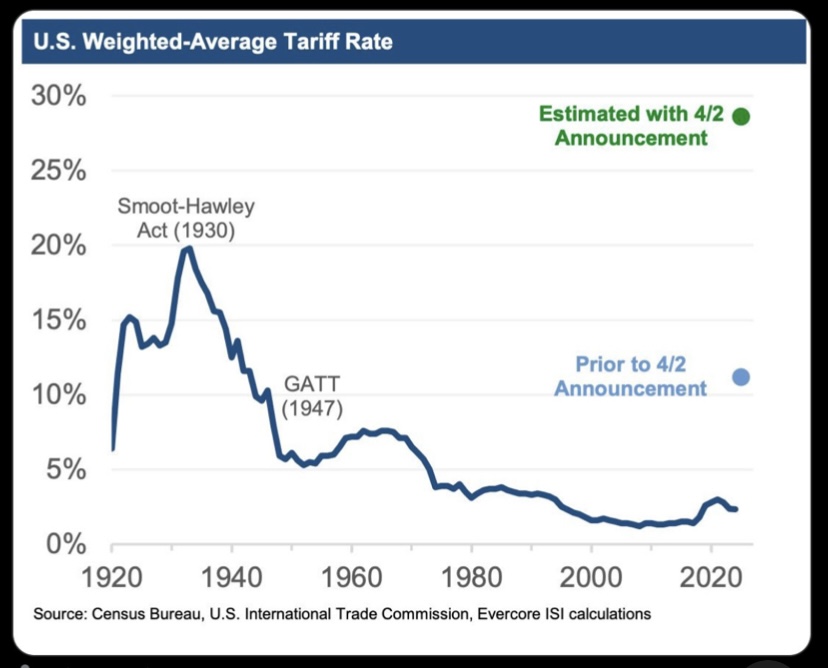
This chart shows the US overall weighted-average tariff. The blue dot on the right is just before April 2. The green dot is with all of the April 2 announcement included; the highest rate in over 100 years. Higher even than under Smoot-Hawley.
Of course, none of this may come to pass. The power to impose trade tariffs rests with Congress, not the President. Senators Chuck Grassley, Republican of Iowa, and Maria Cantwell, Democrat of Washington, are trying to remind their colleagues of this, today introducing the Trade Review Act of 2025, a bill which would require the president to notify Congress of new tariffs within 48 hours of imposition; gives Congress 60 days to accept or reject them; and also requires the administration to explain the reasoning for new tariffs and provide an impact assessment for American businesses and consumers.
Even so, a great deal of damage has already been done. Various US stock indices are tanking and economists are busy raising expectations for a recession in the US this year. Because if there’s one thing business hates it’s unpredictability. The Global Economic Policy Uncertainty Index has hit a new record high, above even the level it reached during the Covid pandemic.

Even a temporary disruption of trade patterns will impact a global economy that is only just recovering from the supply disruptions and inflation triggered by the pandemic (and by Russia’s invasion of Ukraine). The EU reportedly is considering slapping tighter regulations and taxes not just on US goods but on US services, which would hit providers like Bank of America and Amazon. What can be destroyed in a matter of days will take years to rebuild, including the role of the US in the global economy and decades of international diplomacy with allies.
Remember the Boston Tea Party? That was a protest against tariffs.
Meanwhile, the decimation of the scientific and health system continues, with thousands of staff fired from the National Institute of Health and its various subsectors on April 1. Tensions between the US and Iran are heating up. Yet another mammoth severe weather system is churning across the central US. Not only has no one of consequence been fired after Signalgate, there are ongoing revelations about senior staff conducting national security discussions over Gmail. The administration admits to sending “innocents” to a foreign gulag but shrugs and says “oopsie, well, nothing we can do about it now.” The President is apparently making personnel decisions based on recommendations from far right conspiracy theorist Laura Loomer. And the government has fired almost everyone at the Institute of Museum and Library Services.
Oh, and the US imports most of its paper from Canada, Mexico, and China. It might be time to stock up on toilet paper again.


