Super Bowl LI

This Sunday America will be brought together in one of the few events that pretty much everyone in the country watches, or at least has some opinion about. Yes, it’s Super Bowl time — the final game of the (American) football season. But the adverts, the half-time show, and the food are equally as important as the actual game.

On Sunday evening the New England Patriots will play the Atlanta Falcons at NRG stadium in Houston, Texas, for Super Bowl LI (that’s number 51 for those who don’t know their Latin numerals; I haven’t the faintest idea why the Super Bowl is numbered this way). This marks the culmination of a season that started with pre-season games back in August. There are 32 teams in the National Football League (NFL), divided into two conferences. After each team has played 16 regular season games, the four best teams in each conference go into the playoffs; the final two meet up in the Super Bowl.

This year, punters are expecting a high-scoring game, with the Patriots favored to win by three points. This is their ninth appearance at the Super Bowl (the most of any team). Sunday marks the Falcons’ first trip to the Super Bowl since 1999 and only the second in the franchise’s history. So, naturally, a lot of people will be rooting for the Falcons just because they’re sick of seeing the Patriots win.

img_0002

As I know next-to-nothing about (American) football, despite being married to a lifelong fan, I’ll avoid saying anything else about the actual game. Which is fine because, as with most American events, shopping, entertainment, and food are a big part of the whole thing.

Ads

For every analyst pontificating about the strengths and weaknesses of the two contestants, there is at least one more who is focused on the ads. By Monday morning there will be a slew of articles and media blurbs on the “best and worst” ads of the game. It’s like waiting for the annual John Lewis Christmas ad to drop — only much, much bigger. Personally, I’ll only be paying attention to the TV screen when the ads come on.

(http://www.superbowl-commercials.org has the current crop of “leaked” and previewed commercials for Super Bowl LI, as well as most of the ones from past seasons.)

The rights to broadcast the game cycle among the major broadcast networks; this year, it’s the turn of the Fox network. Fox reportedly set this year’s base rate for a 30-second commercial at $5 million (the same as CBS charged last year). At those prices, it’s not surprising that advertisers pull out all the stops to create buzz. Some companies have taken to releasing “teasers” for their ads in the week before the game, while others release previews of the full ad on YouTube. Creative pitches with celebrity cameos and special effects are common. In fact, given how bland and uncreative American TV ads tend to be, it’s pretty much the only time you’ll see anything overtly humorous or vaguely risqué.

At the time of writing, there’s a lot of attention on three of the upcoming ads. Snickers (a chocolate bar made by Mars, Inc.) has announced that, for the first time in super bowl history, it will be presenting a live commercial (actually, Advertising Age points out that in 1981 Schlitz did a live taste-test commercial, but it would be pedantic to point that out).

Skittles (a small, hard candy also made by a division of Mars) released its ad “Romance” on YouTube on Tuesday; by Wednesday afternoon it was on YouTube’s list of trending videos and had amassed more than 500,000 views. It’s a cute little number with a young man lobbing Skittles at his girlfriend’s bedroom window; inside we see the whole family (along with a guy in a ski mask and a local cop) lining up on the couch to gleefully catch the candy in their mouths as it flies in through the open window.

Budweiser beer has a reputation for producing some of the most iconic and well-crafted Super Bowl ads. In recent years, they’ve gone for “heart-warming” slots that feature their famous Clydesdale horses. The 2015 slot, with a man looking for his lost puppy, was an outright tear-jerker, but so well staged that you could forgive the sentiment.

This year’s ad takes a different tack and is already generating a lot of debate. It’s a minute-long piece called “Born the Hard Way,” which they debuted this week. It focuses on a German immigrant in the mid-19th century who makes it to America, facing an arduous voyage and angry crowds shouting, “You’re not wanted here.” The young man finally gets to St. Louis, where he ends up becoming one half of the duo that created Budweiser. The company says the ad conveys a message about “not backing down from beliefs and dreams,” but after days of protests over President DT’s ban on refugees and immigrants from seven Muslim-majority countries, it’s hard not to see the spot as an overt political statement on the positive effects of immigration. It’ll be interesting to see if the so-called “alt-right” start calling for a boycott of Bud.

The Halftime show

Last year’s Super Bowl was the third-most watched broadcast in US TV viewing history with an average 111.9 million TV viewers. And this doesn’t count people who may have been watching at bars or restaurants. The viewing peak came between 8:30pm and 9:00pm eastern time, when an average 115.5 million people tuned in — for the half-time show. With numbers like that, artists are eager to perform in a show that can make — and occasionally, come close to break — their careers.

My personal favorite in recent years was 2009, when Bruce Springsteen and the E Street band showed how it’s done with a hard-hitting, superbly executed show of rock standards. No flash and glitter, just classy showmanship based on pure skill.

Last year, Coldplay were the headliners, with appearances by Bruno Mars and Beyoncé. While Coldplay’s set was generally forgettable, Beyoncé stole the show, with a dynamic rendition of “Formation” and an overt racial-justice theme.

The most controversial in recent years was the 2004 show headlined by Janet Jackson. Near the end of the high-energy set, surprise guest Justin Timberlake joined Janet on stage and America was briefly treated to a “wardrobe malfunction” swiftly dubbed “Nipplegate.” Yes, America went nuts over a less-than-one-second flash of a woman’s nipple. Her thoroughly entertaining set, complete with calls for the audience to reject bigotry, prejudice, and ignorance, was all forgotten in the ensuing “indecent exposure” scandal. (As I’ve written elsewhere, Americans Can Be So Coy!)

This year’s halftime headliner? Lady Gaga. In a recent interview for CBS Sports she said, “I think the challenge is to look at it and say, ‘What can I do differently’?” This should be good.

Food

The final aspect of all this is the super bowl party. Different families and regions have different preferences but around here the favorites seem to be: chicken wings with various sauces; ribs; pizza; chili; tortillas, nachos, and chips, with dips like guacamole and pico de gallo; and beer. Lots and lots of beer.

Which takes us to one of the more bizarre local Super Bowl ‘traditions’ — the wing bowl. Started by a pair of Philadelphia talk-radio hosts in 1993, this is a local eating contest to see who can snarf down the most chicken wings. It’s held the Friday morning before the Super Bowl and has become quite the media event. The Wells Fargo Center, which seats 19,500, sold out this year — for an event that starts at 4:00 a.m. There are side-contests and the competitors are paraded around the packed arena on floats, escorted by young women in minuscule bikinis called the Wingettes. (No, I’m not making this up.) A large amount of beer is consumed throughout the morning.

This morning’s winner was 50-year old Bob Shoudt, who managed to down 409 wings over the course of two 14-minute rounds and one two-minute final. The oldest Wing Bowl winner, Bob took home $10,000, a new car, a ring and medal, and a fair amount of local media exposure. And if you really want to know, the record stands at 444 wings, at the 2015 Wing Bowl (the dubious honor belonging to one Patrick Bertoletti). It’s not an entirely male sport — last year’s winner was a woman, Molly Schuyler, who won with 429 wings.Today, she entertained the crowd with a solo performance in which she devoured 4.5 pounds of steak and a pound of mashed potatoes in 3 minutes and 18 seconds.

There’s probably something meaningful to say here about the American celebration of excess, but frankly this is just an image I’d rather not dwell on any longer.

fullsizeoutput_754.jpeg

Posted in Uncategorized | Tagged , , , , , , , | Leave a comment

Becoming a U.S. Citizen

I am an immigrant. My story is not unusual; it did not involve any danger, heartbreak, or difficult decisions. As a straight white woman with the “right” kind of accent, my journey from student to green card to naturalized citizen was straightforward. But sometimes it was also downright nerve-wracking and for one brief 30-second interlude mind-numbingly terrifying. Most Americans say the IRS (Internal Revenue Service, the federal tax authority) is the scariest government institution. I think most immigrants would agree, it pales in comparison with the INS (Immigration and Naturalization Service).

Here in Philadelphia, the local news is focusing a great deal on two Syrian refugee families who were turned away from Philadelphia International Airport on Saturday morning, despite having all the valid paperwork and approvals to emigrate to the States. This was thanks to the new President’s Executive Order barring arrivals from seven countries, including Syria. Their nephew told the local media of waiting eagerly at the airport with other family members for his uncles and their families, only to suddenly be told by customs officials that there was no point in waiting as they had been sent back. (Oh, and they had to pay for their return plane fares, too.) I can barely imagine the horror, the helplessness, and yes the rage, that this family must be going through.

Student Visa

Like I said, my own story is very different. I first came to the States in 1985 on a student visa. I applied for this at the American embassy in London, which involved a day of standing in lines and filling out forms (this was pre-internet). I remember at one point having to promise that I was not, and had never been, a member of, or a sympathizer with, any Communist or Nazi party or organization.

The student visa, stamped into my passport, allowed me to enter the US, to study here, and to get certain forms of work that were pre-approved by the University. That’s how I paid the bills and ate during the three-month summer break; I variously worked answering phones at the university student housing office, checked out books at the university library, and did some paid research work.

Green Card

In 1990 I married an American citizen, and set about applying for a green card. This is the Permanent Resident Card that authorizes you to live and work in the States. I would need one if I were to get a job after graduating. Again, hours of filling out forms, gathering documents, and waiting in various offices. I remember the “final” approval interview, when the spouse and I had to appear at the INS offices in downtown Chicago.

This was about the same time as the movie Green Card came out (a forgettable romantic comedy starring Gérard Depardieu and Andie MacDowell). In the movie, they are grilled about all sorts of minutiae to “prove” that their marriage is legitimate, even down to Depardieu’s character being asked what kind of toothpaste his wife used. I remember perching anxiously on a plastic chair in an anonymous waiting room and suddenly turning to my husband and asking him: “Do you know what kind of toothpaste I use?” Naturally, he didn’t have a clue.

When we were finally ushered into a tiny little office, the bureaucrat on the other side of the desk was utterly humorless. But the actual interview ended up being brief to the point of perfunctory. It wasn’t until it was all over that I found myself imagining how very different the day would have been if I weren’t a white woman with an English accent.

A few weeks later the coveted Green Card arrived in the mail. It was actually a disappointingly small piece of plastic, the size of a credit card, pale pink in color, with my name, picture, and details printed on the front, and an alarming black strip on the back with a long list of letters and numbers printed underneath. My entire life, summed up in those numbers and letters, with who-knows-what data embedded in the black strip.

Permanent Resident

From that point on, when I applied for work, or whenever I left the country, I’d carry the little pink card with me, serene in the knowledge that I was a Permanent Resident. The only drawback I could see to not being a full citizen was that I could not vote. Otherwise, to all intents and purposes, I felt like I belonged. Occasionally I’d wonder about citizenship, especially after our first child was born, but I (mistakenly) assumed I’d have to renounce my British citizenship, which I was not prepared to do.

But then came the 30-second interlude of mind-numbing terror. This was the early summer of 1999. I’d been on a ten-day business trip that took me from Philadelphia to Singapore (by way of Amsterdam), on to Hong Kong, and then back via San Francisco. I literally circumnavigated the globe. By the time my plane landed in SF on Saturday morning, I was so jet-lagged out of my skull I didn’t even know what day it was, let alone the time. I was also feeling rather ill (it later turned out I was in the early stages of pregnancy with son #2).

I stumbled up to the Border Control desk at the airport, and handed over the British passport and Green Card. The agent stared long and hard at my Card, then looked up, leaned forward and sternly said, “Do you know how long you’ve had this?”

I was paralyzed with terror. Oh my God what have I done wrong? Has it expired? My husband and (US-born) child were on the other side of that barrier — would I ever see them again?

After what felt like an eternity but could only have been a few seconds, he said, “You’re eligible for citizenship! Why haven’t you applied yet?” Still scared witless I stammered something about “Been meaning to…” He handed me back my precious little pink card and said, “Well see that you do, young lady, see that you do. We need people like you!”

I staggered past his desk into baggage control and collapsed on the nearest bench, near-weeping with relief (remember: jet-lagged and pregnant, not a good combo). It wasn’t until much later that I wondered if “people like you” was really as creepily exclusionist as it sounded, or if he was just trying to be nice. But it worked: I set about figuring out citizenship in earnest.

Citizenship

Once I realized that the INS wouldn’t actually demand that I physically hand over my British Passport — and that Her Majesty’s Government couldn’t care less how many additional citizenships I claimed — the decision was easy. The year after #2 son was born, I applied for citizenship.

Once again, forms, documents, paperwork — and a written test! I dutifully studied my list of 100 sample questions. Some were laughably easy: what American holiday commemorates the first meal the pilgrims shared with native Americans? Others I did have to look up: who is currently the chief justice of the Supreme Court? This part of the whole process was a little anxiety-provoking but I wasn’t particularly worried about the outcome. I also had a rambunctious six-year-old and a toddler running around; who had time to worry about the machinations of the government bureaucracy?!

The process took a little longer than usual because right after I applied, 9/11 happened. Still, I was stamped and approved and told to appear for my swearing-in ceremony at a courthouse in Philadelphia in mid-January, 2002. We got permission from the school for the six-year old to come along, figuring it could be an important learning moment for him. In the event, while he did try very hard to be good, the stuffy and crowded room full of strangers didn’t impress him in the least. But for me, the whole morning was profoundly moving.

The judge told us there were about 80 of us becoming citizens that day, from over 60 different countries. I remember a young woman from West Africa, who was crying tears of joy and hugging everyone she saw. An elderly Laotian couple, bent double, escorted to the front of the room by a solicitous grandson who helped them sign their names. A tall, middle aged Indian woman, regal in a beautiful sari, and utterly serene until her name was called and she broke into the most radiant smile. A young French man, trying his hardest to be cool and diffident while his American wife wept and snapped photos.

It was America at its most gloriously diverse and its most powerful best. Every single one of those people had a story — and you could tell that for many of them, this day marked the culmination of a long and harrowing journey. Most of us were in tears by the time we all stood to say the Pledge of Allegiance for the first time. I was bursting with pride.

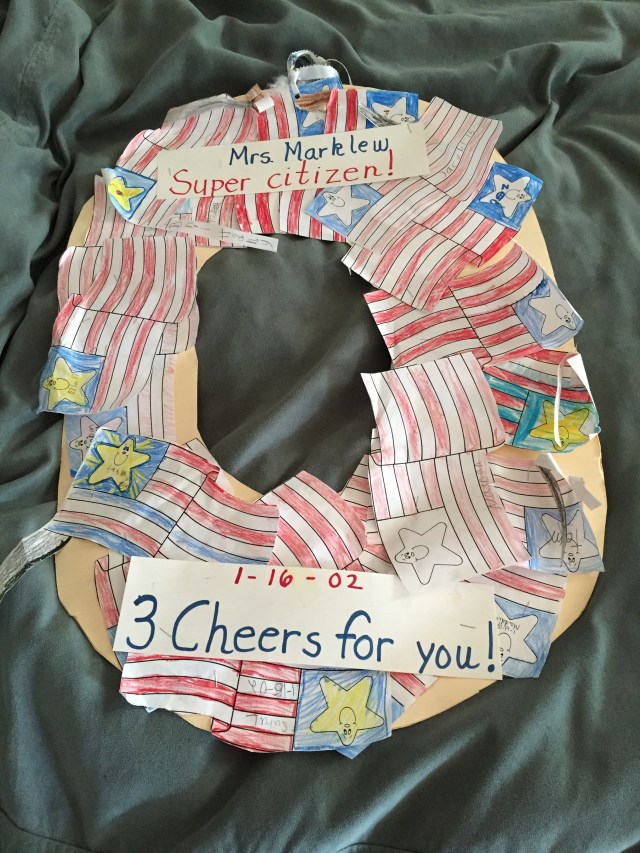
The final part of the day was when we returned the six year old to school. My husband insisted I needed to walk him into the classroom. When we opened the door, 20 six-year olds were sitting at their tables, with little American flags in front of them, and they all cried out “welcome.” It turned out that the teacher had found out why our son would be absent from school that morning, and decided to turn the event into a civics lesson for the kids. We got to share red-white-and-blue decorated cupcakes, and I had to try very hard not to cry all over again.

Each student in the class had decorated a flag that the teacher made into this wreath (it still hangs on the wall of my office). And each of them also wrote a sentence in a little booklet about why they were proud to be Americans. Some said things like “because my grandpa got to come here.” Many said “because of the firefighters” (this was just four month after 9/11).

img_1545

May every one of those refugees and immigrants so cruelly turned away this weekend eventually be admitted. Because while they need the sanctuary and prosperity that this country offers, America truly needs them.

Posted in Uncategorized | Tagged , , , , | 1 Comment

The Blogs I Follow

One of the wonderful things about the world of blogging is the connections you can make with people whose lives may be very different from your own. If you’re a (somewhat) regular reader of this blog, you’ll have noticed some links over on the right-hand pane to other blogs that I follow. The one thing these have in common is that (with one exception) they in some way reflect the expat experience; but their differences are what make these blogs really fun to follow.

In no particular order (except how they’re listed on my page) here’s a look at some of my favorites.

The Kitchens Garden

Written by Cecilia G. (“Celi”) this blog tells the story of her life “developing a mostly sustainable/mostly self sufficient/mostly organic farm to feed ourselves with, out here in the Midwest of America.” Celi is an expat from New Zealand, where she was a High School Teacher of Drama for ten years. Now, she spends her days dealing with runaway pigs, stubborn chickens, and the kinds of weather extremes that you can only find on the open plains of Illinois.

I love reading her daily blog for the photos of life on her farm — a world away from my warm and comfortable suburban house — and for her periodic philosophical musings. If you get a chance, check out some her recent posts: Waste Not Those Feet (January 24) and Is That Art? (January 26) were two of my recent favorites, posts that make you pause and think anew about your world.

Marta Lives in China

Marta is a Spanish expat who has lived in China since 2006. She blogs about life in Suzhou with her Chinese boyfriend “and our chubby golden retriever.” Sometimes she describes taking foreign visitors on treks around Suzhou, with lots of photos of the area.

This blog has been eye opening, though, for showing the kinds of details about life in another country that you just can’t get from newspapers and TV. One recent example: Her January 16 post “How to Survive Winter in Suzhou” revealed that there is no central heating there and houses are badly insulated, so “it is often as cold inside as outside.” Did you know that, starting in October, Chinese people start wearing their long underwear? Until I came across Marta’s blog, I never pictured Chinese people wearing LongJohns.

Careful Cents

This one is not about the expat life, but about being a freelancer. Created by Carrie Nicholson, Careful Cents is “a community of solopreneurs and freelancers who are committed to building life-centered businesses.” Her website is full of useful information and advice about starting and growing a freelance business. She has also written a lot of stuff on personal finance and financial organization. If you’re a new freelancer trying to figure out how to make this work, or a seasoned independent looking for ideas on generating more income, you should check out Careful Cents.

Carrie also runs a Careful Cents Facebook community, where members post questions and stories, and ask for help with particular problems. As someone new to the world of freelance writing, I’ve found it inspiring and helpful.

Expat Mum

This is the blog of prolific writer and blogger Toni Summers Hargis. Originally from the northeast of England, Toni has lived in the States for a couple of decades, mostly “trying to come to terms with the oppressively hot summers and unbearably frigid winters of Chicago.” (As someone who also lived in Chicago for a number of years, I’d put Philadelphia summers well ahead of Chicago’s for oppressive heat, but Chi-town wins hands down on the winter stakes.)

Toni can also be found occasionally writing for the Wall Street Journal, the BBC, and a slew of other publications. Her posts are spot-on accurate about life as a Brit in the USA, ad often laugh-out-loud funny. She’s also a lovely human being — even though we’ve never met, I can say this because she responded immediately when I emailed her out of the blue asking for help with blogging.

She’s also written a book which was updated last year: “The Stress-Free Guide to Studying in the States; a Step-by-Step Plan for International Students.” I wish it had been available back in 1985 when I first came here as a grad student…


Expats Blog

Finally, at the bottom of the pane you’ll see a link to expatsblog.com. This is a site dedicated to the expat experience with interviews, articles, practical information, and links to some excellent blog posts. A quick glance at today’s front page has interviews with a “small town Texas girl living in Germany,” a French expat living in Saudi Arabia, and a Swiss woman raising her kids in Australia. It’s a fascinating look at the differences that unite us.

Posted in Uncategorized | Tagged , , , , , , | 5 Comments

The First Three Days

It’s been an extraordinary three days on the American political scene. I didn’t set out to write a “political” blog but it’s impossible to be a citizen of the USA right now and NOT have something to say about this current political transition. I’ve lived here for just over 30 years, and DT makes my sixth president, but I’ve never seen anything like this.

Numbers and Alternative Facts

First came The Inauguration on Friday. Much has been made of the fact that the crowds on the Mall in Washington were much smaller than those at Obama’s first inauguration in January 2009. This is the comparison photo that’s gone viral.

fullsizeoutput_73c

Actually, DT’s crowd was more comparable in size to some earlier Republican inaugurations, which just goes to show how much energy and excitement there was around Obama back in 2009. According to politifact.com, crowd estimates for Obama in 2009 stood at about 1.8 million; the crowd at George W. Bush’s inauguration in 2001 was about 300,000; and Bill Clinton’s in 1993 drew a crowd of about 800,000. Which puts the 250,000 – 600,000 estimated for DT’s crowds at about par for the course for a not-wildly-popular incoming president.

So, the attendance figures weren’t that exceptional — but the new administration’s reaction to reporting on those numbers certainly was. In one of the most whiny and bad-tempered press conferences I’ve ever seen, the new White House press secretary, Sean Spicer, on Saturday claimed the turnout was “the largest audience to witness an inauguration, period” — something demonstrably false — then went after the media for their ‘misleading’ reporting.

Meanwhile, DT was paying a visit to the CIA headquarters where he said in his speech that the whole “feud” between him and the intelligence community had been created by the media: “They sort of made it sound like I had a ‘feud’ with the intelligence community,” he said. “It is exactly the opposite, and they understand that, too.” [As reported in the New York Times.] Another wild assertion that is demonstrably untrue.

The next day, the various Sunday morning “talking heads” political shows on TV had a field day with all this. But the real eyeopener came on the show “Meet the Press” which is broadcast on the NBC network. DT’s Senior Counselor Kellyanne Conway was being interviewed by Chuck Todd; he pushed her repeatedly on the issue of Spicer’s clearly-false statements on Saturday about the size of the inauguration crowds. Conway said that these were not falsehoods: “Sean Spicer, our press secretary, gave alternative facts to that.”

Within hours, “alternative facts” was trending across all social media.

It’s not at all unusual for a new administration to have some hiccups with communication in its early days; no press secretary or spokesperson is seasoned and polished right off the bat. But, to start your new administration by openly attacking the media and accusing everyone else of lying is so staggeringly inept that it defies belief. Fortunately, the collective media do not seem to be taking this lying down — if the major news outlets had gone after DT’s bombastic lies more thoroughly when he was campaigning, we might not be in this mess now.

The Speech

Now let’s rewind for a moment to the inaugural speech itself. It always intrigues me how much pomp-and-circumstance surrounds the start of each new administration here. The contrast with a parliamentary system where governments come and go all the time is striking. (Only the French come close, with their hybrid political system that emphasizes the role of the president, and a love of ceremony and pomp to go with it.)

One of the highlights of the whole thing is the new president’s speech. These are mostly pretty dreadful affairs, full of empty froth about moving forward, with a dose of humble thanks for the previous administration and for ‘all those who helped to get us here.’ God features in there somewhere (this being a country where no political leader can make a major speech without invoking God in some fashion). The whole thing is usually vaguely uplifting and patriotic and utterly forgettable.

Obama’s speech in January 2009 was built around the phrase “A New Birth of Freedom” from Abraham Lincoln’s Gettysburg Address. Obama referred to ideals expressed by Lincoln about renewal, continuity and national unity, stressing the need for shared sacrifice and a new sense of responsibility to answer America’s challenges at home and abroad. It was pretty stirring stuff.

Once again, the contrast with DT couldn’t be more stark. Trump’s speech described an utterly dystopian vision of an America of “rusted-out factories scattered like tombstones across the landscape of our nation” where “the wealth, strength, and confidence of our country has disappeared over the horizon.” He pointed to “the crime and gangs and drugs that have stolen too many lives and robbed our country of so much unrealized potential.” He also said that the education system is failing our children even though it is “flush with cash” — a description that had all the teachers I know howling in derision. And of course he made the declaration that promptly spawned a myriad of social media memes: “This American carnage stops right here and stops right now.”

There were the usual calls for unity (which rang hollow with a resounding clang after the tenor of much of his campaign) and claims that “our country will thrive and prosper again.” But, not only was the overall tone notably bleak, it sounded less like a new leader laying out his vision for the country and more like a campaign speech.

From the tone of this speech to the weekend’s complaints about media bias and the focus on “alternative facts” this is an administration that has yet to grasp the significance of governing or the burden of what it means to lead.

The Women’s March(es)

Which takes us to the final, extraordinary part of the weekend — Saturday’s marches. The numbers are still being tallied, but it appears that at least 3 million “women and allies” demonstrated in cities across the USA on Saturday, literally from Seattle to Miami and all points in between.

fullsizeoutput_71afullsizeoutput_737

And not one report of violence breaking out; not one arrest. The group of women who organized the march here in Philadelphia were hoping for as many as 20,000 to show up. Saturday afternoon, the mayor’s office put the number at 50,000. I wasn’t able to go but many friends and neighbors went either to Philadelphia or down to Washington DC. They all reported a positive and joyful experience, inclusive and diverse and downright uplifting.

This is the logo that someone came up with for the Philadelphia march. For anyone who doesn’t recognize it, that’s the iconic Liberty Bell, housed here in Philly, with an added women’s symbol.

fullsizeoutput_739
These two photos are from the Philadelphia march Facebook page.

fullsizeoutput_736fullsizeoutput_72f

And here’s one final shot of the front page of Sunday morning’s Philadelphia Inquirer. Many march organizers, including the extraordinary women who set up the one here in Philadelphia, are planning to keep the momentum going. I look forward to what comes next.

fullsizeoutput_718

Posted in Uncategorized | Tagged , , , , , , | Leave a comment

The SAT

One of the many challenges of raising a family in another country is getting used to an educational system that’s totally different from the one you grew up with. For me, pre-university testing was all about the subject-based A-level exams; most of mine were essay based. For my kids, it’s all about the standardized tests called the SAT and the ACT. My youngest, who is a junior in high school (i.e., one year away from high school graduation) is about to sit the SAT for the first time this Saturday.

The SAT — originally the Scholastic Aptitude Test, and now universally known just by its acronym — was introduced back in 1926. It’s run by a private, not-for-profit institution called the College Board. The original intent was to come up with a way of judging a student’s readiness for university study in a meritocratic way, irrespective of the student’s background or intended course of study. The reality, of course, is rather different.

The SAT has been revamped periodically, most recently in 2016. The latest version is broken down into two sections — mathematics, and critical reading and writing. Each section is scored out of 800 points, to give an overall score out of 1600. The timed test takes three hours to finish. Most of the questions are multiple choice, with the student using a #2 pencil to fill in the bubble for the appropriate answer. (You don’t lose points for a wrong answer.) There’s an optional additional SAT essay that you can take at the end of the basic test, which is also scored out of 800 and takes another 50 minutes to complete.

These next two pictures of sample answer sheets are from one of my son’s SAT test prep books. Just looking at these rows of a/b/c/d bubbles gives me a migraine. On the plus side, I guess you don’t get the epic hand-cramps I remember from frantically writing four essays in three hours for A-level history (lots of “Compare and contrast the causes and consequences….”)


The remaining pictures in this post are from the sample tests you can find on the College Board website: https://collegereadiness.collegeboard.org/sat   I’ve shown the correct answers in these screenshots because, frankly, I’d have a bit of a hard time figuring them out otherwise.

fullsizeoutput_6fc

Taking the SAT (or its competitor, the ACT, which is structured somewhat differently), is required for entry to most universities in the US. Many students intent on getting into university (widely called “college” over here) will take the SAT a couple of times, to try to get as high a score as possible. And college websites routinely tell prospective students the “average” SAT and ACT scores of successful applicants.

There are also a total of 20 separate SAT subject tests that a student can choose to take, in things like languages, maths, sciences and history. Many of the more academically challenging universities require a student to provide one or two SAT subject tests, in addition to the basic SAT.

fullsizeoutput_6fb

None of this is free. Each sitting of the basic SAT costs $45 ($57 if you also do the essay), and a subject test costs $46. You can get these fees waived if your family is on public assistance or meets a low income means test — but of course that means more forms to fill out and more hoops for the student to jump through. The tests are offered about seven times a year, at thousands of locations across the USA.

Needless to say, SAT preparation classes are a highly lucrative business. So, of course, the kids from better off families who can afford such prep classes get a better shot at a higher score. With the revamped test, the College Board has partnered with the online Khan Academy, to provide students with tons of test prep advice and courses, all for free.

fullsizeoutput_6fd

The College Board claims that the revamped test launched last year is “more focused on the skills and knowledge at the heart of education.” They say it measures what students learn in high school as well as what they need to succeed in college. The emphasis is more on analysis and solving problems, and less on obscure vocabulary.

My older son took the previous version of the SAT, which had three sections and was scored out of 2400. It included a vocabulary testing section that was notorious for asking students to identify synonyms and antonyms of words that no-one was ever likely to encounter in the 21st century. This older son used a private tutor to prepare for the test: a former teacher with unruly grey hair and an impish smile, she cheerfully described the vocab section as ‘a piece of torture dreamed up by nazi war criminals hiding out in NJ.’

And, if you want to go on to any form of post-grad education, like a master’s or a doctorate, you’ll almost certainly have to take another standardized test, called the GRE (Graduate Record Examination). This has sections on verbal reasoning, analytic writing, and quantitative reasoning, i.e., maths. Because I wanted to go to graduate school in the States, I had to take the GRE at a London testing center back in 1984. As someone coming from a heavily essay-based educational background, I aced the verbal and writing sections. But I’d dropped maths once I got my O-level, which meant I walked into the GRE and found myself staring at the kinds of algebra and trigonometry questions I hadn’t seen in eight years. Needless to say, that section did not go well.

Hopefully, the 16-year old is better prepared for Saturday’s four-hour testing marathon.

Posted in Uncategorized | Tagged , , , , | 2 Comments

Martin Luther King Day

Tomorrow, January 16, is Martin Luther King day here in the States, honoring the memory of the civil rights leader. This federal holiday has been observed since 1986 and is always on the third Monday in January (close to King’s actual birthday on the 15th). It has also become known as a Day of Service, “a day on, not a day off,” because as Dr. Martin Luther King Jr. once said, “Life’s most persistent and urgent question is: ‘What are you doing for others?’”

fullsizeoutput_6ea

MLK Day is something quintessentially American — turning the shameful history of oppression of African Americans into a day that actively honors a civil rights leader by “doing something good.” Check out http://www.mlkdayofservce.org for some of the events going on in this region.

Making this a Day of Service was started a little over 20 years ago by then-U.S. Senator Harris Wofford (Democrat, Pennsylvania) and Atlanta Congressman John Lewis. They co-authored the King Holiday and Service Act, signed into law by President Bill Clinton in August 1994, which challenges all Americans to honor King’s memory with a day of citizen volunteer action. Local churches, mosques, temples, and synagogues may sponsor day-long events such as assembling care packages for the homeless; shelters and community service organizations hold fundraisers and clean-up events.

But this year, the day has been overshadowed by yet another Trump tweet fiasco. Every time DT does something appalling you think “how can this get worse?” and then it does. This time, he went after John Lewis, an honored scion of the civil rights movement.

Congressman John Lewis — yes, the same man who co-sponsored the Day of Service legislation — is one of a handful of Democratic Party members of Congress who have announced they will not be attending DT’s inauguration on the 20th.

In a TV interview released on Friday, Lewis said: “I don’t see this President-elect as a legitimate president.” DT, predictably, took to Twitter in response, saying on Saturday: ”Congressman John Lewis should spend more time on fixing and helping his district, which is in horrible shape and falling apart (not to mention crime infested) rather than falsely complaining about the election results. All talk, talk, talk – no action or results. Sad.”

To understand just how appalling this is, you need to know who John Lewis is: He was the youngest of the “Big Six” leaders of the 1963 March on Washington, when he was chairman of the Student Nonviolent Coordinating Committee, a key part of the civil rights movement. Before that, he had been one of the 13 original Freedom Riders — frequently beaten by mobs and arrested, for campaigning to uphold the desegregation of interstate bus travel.

The following two pictures are taken from my copy of the book “Eyes on the Prize” by Juan Williams.


fullsizeoutput_6e8

fullsizeoutput_6e7

In March 1965, John Lewis was beaten by Alabama State troopers at the Pettus Bridge in Selma, Alabama (a day known in the history of the civil rights movement as Bloody Sunday). His skull was fractured; his head still bears the scars. He has represented Georgia’s 5th Congressional district since 1987 — re-elected 14 times. This man has “walked the walk” as much as any human being could.

This picture is from the Associated Press, 1965

fullsizeoutput_6eb

You have to wonder whether DT really is this stupid, or whether this was an attempt to distract us all from the story “leaked” (pun intended) by Buzzfeed earlier in the week — you know the one, about the alleged blackmail-worthy dossier that the Kremlin is using to exercise a hold over DT. As a distraction, it failed utterly. The whole Golden Showers thing is just a gift to every comedian in the country.

And as a backdrop to all this, we have the ongoing confirmation hearing for DT’s nominee for the post of Attorney General, Jeff Sessions, a Republican Senator from Alabama. The Attorney General is the head of the US Department of Justice and essentially the government’s chief lawyer. Sessions’ nomination has drawn widespread outrage: in 1986, his nomination to a federal judgeship was rejected by a US Senate committee because he had made numerous racist statements, including referring to civil rights groups as “un-American” and trying to “force civil rights down the throats of people who were trying to put problems behind them.” He opposes the Voting Rights Act, and has a history of supporting anti-immigration legislation.

Even his full name is cringe-worthy: Jefferson Beauregard Sessions III was named (after his father and grandfather) for Jefferson Davis, President of the Confederacy, and General P.G.T. Beauregard, commander of the first Confederate army at Fort Sumter, at the start of the American Civil War. Incredibly, these names are still fairly common among certain families in the southern USA.

On so many levels, this confluence of news stories just beggars belief. I keep expecting to wake up from this dystopian nightmare and discover that reality has resumed. But no such luck.

Incidentally, there is one excellent side effect of all this: Lewis’s books on the civil rights movement have suddenly become hot items — “Walking with the Wind: A Memoir of the Movement” and “March,” a graphic-novel trilogy about the civil rights movement, were listed as “temporarily out of stock” on Amazon Sunday.

Posted in Uncategorized | Tagged , , , , , , , | Leave a comment

Interview at Expats Blog

I recently did an interview for the Expats Blog website. The link below takes you there.

http://www.expatsblog.com/articles/1954/british-expat-living-in-usa-interview-with-vicki

Posted in Uncategorized | Leave a comment

First Snow of the Year

We had our first snow of the year overnight — a two inch covering that was just enough to make everything look lovely but not enough to seriously inconvenience. This rather annoyed my high schooler, who was hoping for a two-hour “snow delay” (where the school opens two hours late to give time for the streets to become drivable).

img_1509

It was fairly easy to clean off the cars first thing and — thanks to some preemptive brining followed by frequent ploughing by the borough — the streets were clear by 7:30 a.m. The distinctive brine marks on the streets yesterday evening, whitish swirls left behind by the spraying of a salt solution, were a sure sign that snow was on the way. (When we used to live in Chicago, which gets significantly more snowfall in any year than this region, you knew a storm was coming when snow ploughs would quietly line up near the major highways or be parked near key intersections.)

IMG_1518.JPG

IMG_1510.JPG

This is one of the many benefits of living in a small town — the snow plough can get to most of the streets in a fairly short period of time. The same is not true within the city of Philadelphia itself, where clearing of smaller side streets basically equates with “wait for the thaw.”

fullsizeoutput_6d9

img_1515

Aside from digging out the car, the worst part of snow in the ‘burbs is having to clear off your stretch of sidewalk — something you’re supposed to do within 12 hours of the snowfall ending. As the temperature looks set to remain below freezing for the next few days, this looks like one of those times when warmer temperatures won’t help the snow to melt away, so I’ll have to venture out with the shovel.

IMG_1519.JPG

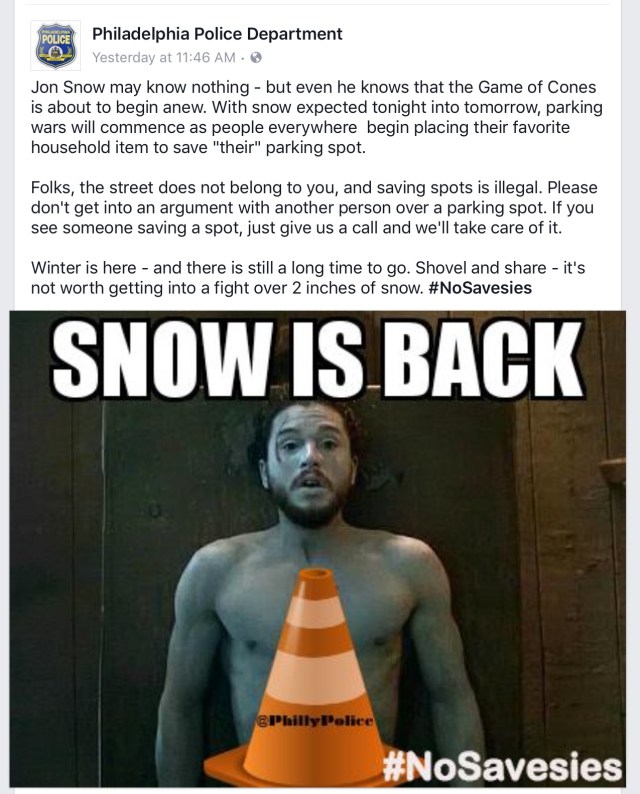
In the city, where finding parking on the street in front of your home is always a battle, snow brings an added dimension of stress — digging out your car in the morning and leaving a nice clear spot, only to come home at the end of the day and find someone else has parked in it. So winter brings the annual struggle over “savesies” — people trying to save their cleared spot with cones, plastic chairs, rubbish bins etc.

This always prompts the Philadelphia Police Department to reiterate the “no savesies” policy. Yesterday’s Facebook post from the department is a classic.

fullsizeoutput_6e4

Posted in Uncategorized | Tagged , , , , , | Leave a comment

Offbeat A-Z List of US:UK Differences

To kick off the New Year, here’s a slightly offbeat A-Z list of some of the less-known differences about life in the USA for an expat Brit:

Appliances: Huge. Especially fridges and washing machines. Our “standard” size fridge is about three times the size of the one we had in the UK.

Beer: Cold. Really cold. Sometimes the mugs in restaurants actually come out of the freezer so they’re covered in ice (which helps to disguise the often non-existent taste).

Cheese: Basic. Very little variety except in hard-to-find specialty shops. “American cheese” barely qualifies as a food product.

Driving: A necessity. Otherwise you can’t get There from Here (except in the heart of the biggest cities, when getting behind the wheel can be considered suicidal).

Electricity lines: Overhead. On poles, like telephone wires — which makes so much sense in a country prone to things like hurricanes, tornados and violent thunderstorms.

Fur babies: Your pet dog or cat. Really. It’s a thing.

Great British Bake Off: Obviously, not a thing over here, but you’d be hard pressed to find any TV show that has that level of national obsession. I can’t think of any show that is universally watched — except the Super Bowl (annual American Football final — more on this in late January).

Humidity: Nasty. Across the south and east of the country it’s a weather phenomenon in a category all it’s own, complete with humidity ratings. (And in August it’s brutal.)

Ice cream: Always. There is no weather too cold that Americans won’t serve ice cream. And no flavor that you can’t find (jalapeno? sweet corn? bacon?). It’s like crisps in the UK.

Judges: Elected. They run for office, collect campaign contributions, and make promises.

Kilometers: None. The metric system has made zero inroads in America; here, it’s all pounds, inches and gallons.

Low mileage: Cars. They get staggeringly-low miles per gallon; 25 mpg is normal, some SUVs get as little as 12 mpg, and a Prius getting 46 mpg is considered “awesome.” (see Petrol, below)

Milk: Homogenized. All of it. Which means the stuff can last 2-4 weeks in the fridge but there’s no such thing as cream on the top. And tea just doesn’t taste the same.

Naan: Rare. Tough to find outside the larger cities. Chinese restaurants are to America what Indian restaurants are to the UK.

Oxo: Nope. Doesn’t exist here as a food brand, so don’t bother looking for those beef stock cubes.

Petrol: “Gas”. Staggeringly-cheap. Varies by city and state depending on supply and local taxes, but the current average across Pennsylvania is $2.58 a gallon. (Assuming 3.8 liters a gallon and an exchange rate of $1.23 per pound, that translates to about 54p a liter.) (see Low mileage above)

Quidditch: Really. There are teams and leagues and the 2016 Quidditch World Cup was held in April in South Carolina. (I’m not making this up: http://www.usquidditch.org)

Rabbits: Suburban pests. Our back garden (see Yard below) is full of them, but you can never find the burrows.

Sales tax: Ubiquitous. Varies by city and state, and NEVER included in the listed price of anything. So, that bottle of shampoo that has a $4.99 price sticker will actually cost you $5.29 with the 6% Pennsylvania state sales tax added on. Same with hotels and cars, which adds a hefty mark-up to the final purchase price (unless you live in the lovely little state of Delaware, which has no sales tax at all).

Traffic lights: Straight to green. After red, there’s no friendly get-ready red-amber combo first. Makes accelerating away from the traffic light feel like the start of a Grand Prix race: aaaand GO!

Umbrellas: Rare. Which is odd, considering it rains here on the east coast just as much as in London or Leicester.

Visitor etiquette: Iced. When you stop by a friend’s house, they routinely offer a cold drink, loaded with ice –water, fruit juice, soda, even (shudder) iced tea, whatever the season. If you do get offered something hot, it’s always coffee, maybe hot chocolate in the depths of winter. But not tea.

Wild life: Extensive. Even here in the heart of the great east coast conurbation. In the past 20 years, our back garden has been visited or inhabited by deer, mice, racoons, squirrels, voles, turkeys, rabbits, chipmunks, groundhogs, foxes and a skunk. Plus birds from tiny hummingbirds up to big predators like red-tailed hawks. And don’t get me started on the list of bugs…

Xmas lights: Everywhere. Widely festooned on the outside of urban and suburban homes starting right after Thanksgiving in late November, and left up as late as mid-January. Sometimes tastefully-draped ribbons of white lights around windows and trees, sometimes garish riots of color (including lights shining onto the house itself), and often with added life-size inflatable statues of Santas, deer, and snowmen (sometimes inside a clear inflatable globe).

Yards: Gardens. The general name, whether front, side or back is yard, not garden. So, people will say “my back yard is over-run with rabbits” when the “yard” is actually a beautifully-landscaped suburban oasis.

Zebra crossings: None. Cross a road at your peril, unless you’re at an intersection with a traffic light. But, this is America, where people believe in lawsuits as a deterrent so even traffic lights are not sacrosanct. In any case, odds are you’re driving, not walking.

Posted in Uncategorized | Tagged , , , , | 2 Comments

Americans Can Be So Coy!

In many ways, America is surprisingly coy and uptight. This may come as a surprise to many, given that American popular culture is laced with sex and violence. I’m still a bit shocked at the overt sexual innuendo on regular network TV shows like Two-and-a-Half Men, which broadcasts quite early in the evening.

But, everyday discourse is laced with all sorts of coy phrases to avoid invoking anything to do with death or the toilet; and swearing is a big no-no.

Nobody Dies

Not true, of course, but Americans are notably squeamish about any discussion of death. In part this may be part of the whole “optimistic Americans think they’ll live for ever” thing (Fundamental Differences: Britain vs USA).

But, no-one here dies. Instead, they “pass away,” “pass over,” or just plain “pass” — as in “he passed yesterday.” Which always makes me want to retort: “What, was he a kidney stone?”

When I told people earlier this year that a very close relative had died they would visibly flinch, then say something like: “Oh, she passed? I’m so sorry for your loss.” No, she didn’t “pass” and I didn’t misplace her somewhere. She’s gone. And I don’t see that refusing to call it what it is can help someone grappling with extreme grief. Hearing anyone describe death as “passing” just makes me want to smack something. But that’s just me.

Restrooms

Also, no-one in America uses the toilet. Instead, it’s called the bathroom or, even more baffling, the restroom.

Some years ago, wending my way through the exhausted chaos of Heathrow airport arrivals one morning, I overheard a jet-lagged American woman approach a friendly British copper and ask where she could find the nearest “restroom.” Bemused, he scratched under his helmet and said, “Well, madam, there are some comfy chairs in the arrivals hall; I suppose you could rest there?” Mutual incomprehension ensued. I was on the other side of a barrier so couldn’t come to her rescue; I have no idea if she ever found relief.

And don’t bother looking for — or asking for — toilet paper in the shops. It’s coyly called “bathroom tissue.” And even adults will routinely use infantile words like “peepee” or “poopie.” Someone once warned me: “Oh, you’re almost out of peepee paper in your bathroom, dear.” Good grief. Maybe there are more earthy words in some regions, although I’ve never heard them. Fortunately, I can use the word “loo” quite freely and people find it amusing.

Swearing

Which takes us to swearing. Plenty of people (like me!) swear with impunity and on cable TV there are F-bombs aplenty. Yes, that’s what they’re called — as in “OMG, I can’t believe she just dropped an F-bomb!” Pretty obvious what it stands for. Again, coyness abounds. Conversely, there are no holds barred on paid/cable TV (think Game of Thrones, True Blood, or Orange Is The New Black).

But, you will never ever hear any kind of swear word on broadcast network TV at any time of day or night. There is a general concept of safe harbor, meaning that “inappropriate” content should not be broadcast during “family friendly” daytime and early evening hours. So shows like CSI or Elementary, which have “adult themes” (murder, drug use, prostitution) are generally not broadcast until after 9:00pm — although given how much rebroadcasting there is the concept is a bit laughable. Even so, you will never hear a cast member on CSI swearing while going about the gruesome business of collecting samples from a half-decayed corpse.

And, what Americans consider swearing would be laughable if it weren’t so bloody annoying. I’ve seen TV shows where they bleep out “God damn” or change “damn” into “dang”. “Hell” gets replaced with “heck” and anything stronger is just bleeped out altogether. Which makes certain reality shows pretty much unwatchable (well, they’re unwatchable for a lot of reasons, but the incessant beeping doesn’t help).

I’m actually typing this up at a local garage at 3:00 o’clock in the afternoon as my car gets worked on, while the TV in the corner is broadcasting a staggeringly awful daytime “reality” show about the horrendous things some men do to their wives (The Maury Show). Every time someone swears (which is a lot) it gets beeped out; but, the obvious references to how these men treat their women and the “sexual acts” they expect is just fine. And this at 3:00 o’clock in the afternoon.

So, despite the early-evening “safe harbor” concept, with adult discourse supposedly allowed after about 9:00pm, it’s hard to tell the difference. Two-and-a-Half-Men is OK, but hearing someone utter the word damn is not?! A British TV show like The Thick Of It would never get picked up by broadcast American TV; aside from the political references not translating well, the sound editors just wouldn’t be able to get the script to make sense after all their edits.

Conversely, Americans have no qualms about discussing how much something costs or their personal religious beliefs (subjects no proper Englishwoman would dream of discussing in casual conversation). And they have zero reticence about discussing medical issues. There are adverts aplenty on TV at all times of day for everything from viagra to tampons to hemorrhoid medicines.

So, you can talk about grandad’s need for viagra but not about him dying; you can tell everyone about how Jesus is your personal saviour but you can’t ask where the toilet is; and at 7:30 in the evening your kids can see a well-known comic actor talking in a TV show about how long it’s been since he last got laid, but at no time will you hear him talking about needing to go for a shit.

Posted in Uncategorized | 2 Comments